
Hybrid POS: Local Checkout Speed, Central Business Control
See how local transaction execution and connected oversight can strengthen busy retail operations, then test the exact POS architecture, devices and recovery workflow.
Hybrid POS: Local Checkout Speed, Central Business Control
Choose a stage to explore the practical checks.
Why the location of transaction work matters
Local execution can reduce the amount of coordination needed across a wide-area connection for selected counter tasks. AWS identifies low latency and local data processing as reasons some workloads remain on premises within a hybrid design. AWS hybrid architecture guidance explains that placement decision. Applied to retail, the useful question is which steps of your actual sale require the local machine, a branch server, a central service or an external provider.
Read this part of the guideLocal device control can simplify the counter journey
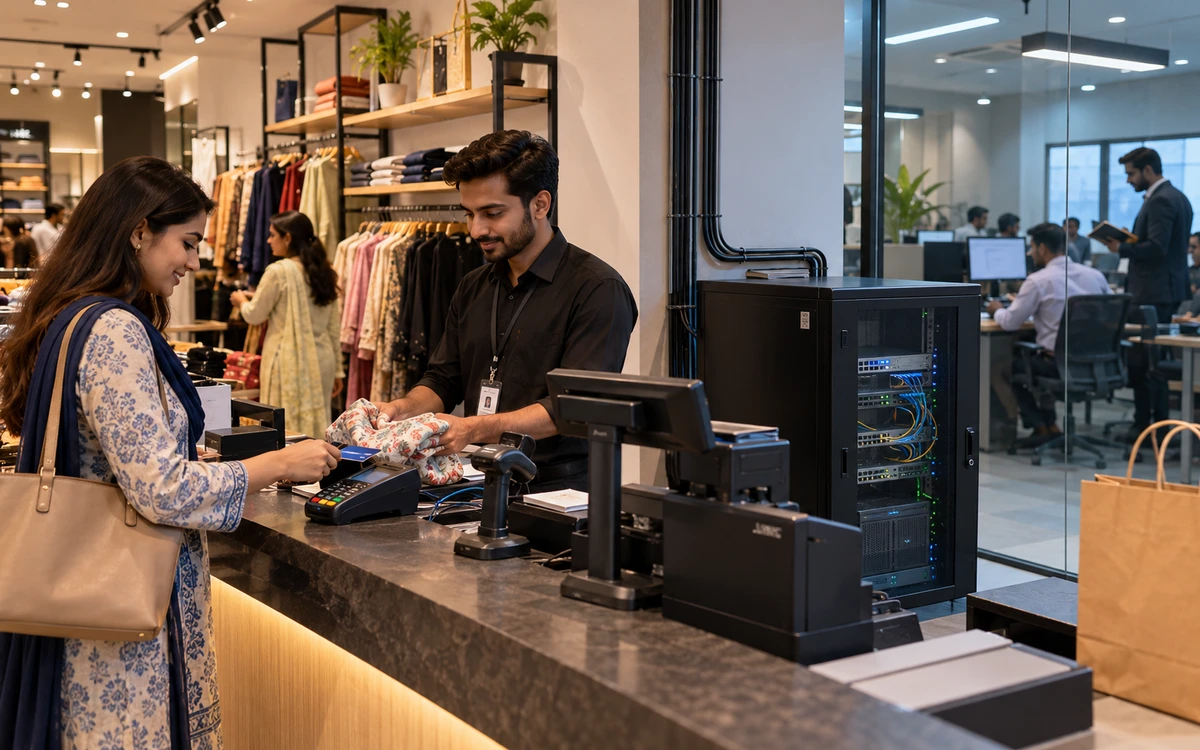
Scanning, receipt printing, cash-drawer actions and customer displays are part of the checkout experience. Keeping supported device communication on a well-managed counter or branch network can make that journey easier to control and diagnose. Staff can distinguish a failed printer connection from a failed central service instead of treating every symptom as the same problem.
Read this part of the guideA practical supermarket scenario
Consider a supermarket where several counters scan mixed baskets during the evening rush. The owner is also reviewing branch results remotely. In a hybrid design with a confirmed local sale path, checkout work can be placed near the counters while management reporting follows its own agreed update path. The cashier's immediate task and the owner's broader review need not compete through precisely the same sequence of remote requests.
Read this part of the guideA busy counter needs a short, predictable path from scanned item to completed sale. Head office needs a dependable view of the whole business. A well-designed hybrid POS architecture can serve both priorities by placing time-sensitive transaction work close to the counter while connecting branch information with central oversight. That is a serious operating advantage to evaluate when a basic browser checkout no longer covers the business's needs.
Why the location of transaction work matters
Local execution can reduce the amount of coordination needed across a wide-area connection for selected counter tasks. AWS identifies low latency and local data processing as reasons some workloads remain on premises within a hybrid design. AWS hybrid architecture guidance explains that placement decision. Applied to retail, the useful question is which steps of your actual sale require the local machine, a branch server, a central service or an external provider.
A hybrid label does not answer that question. Ask for the transaction path. A locally installed application can still wait on a distant service, while a sophisticated cloud product can include carefully designed edge components. The advantage comes from the implemented path and its measured behaviour.
Local device control can simplify the counter journey
Scanning, receipt printing, cash-drawer actions and customer displays are part of the checkout experience. Keeping supported device communication on a well-managed counter or branch network can make that journey easier to control and diagnose. Staff can distinguish a failed printer connection from a failed central service instead of treating every symptom as the same problem.
The business still needs an approved equipment list, reliable local networking and a supported configuration. A driver mismatch or overloaded branch machine can undermine an otherwise sensible design. Include the actual scanner, printer and device settings in the acceptance test, using the POS hardware checklist to prepare the equipment.
A practical supermarket scenario
Consider a supermarket where several counters scan mixed baskets during the evening rush. The owner is also reviewing branch results remotely. In a hybrid design with a confirmed local sale path, checkout work can be placed near the counters while management reporting follows its own agreed update path. The cashier's immediate task and the owner's broader review need not compete through precisely the same sequence of remote requests.
Test that proposition rather than accepting it as a promise. Run an ordinary basket, a large basket and a correction while the intended management views are in use. Record the complete transaction time and any recovery effort. Do not turn an architectural possibility into a claim that a particular iPOS configuration has already achieved an unmeasured result.
Central control should add operational depth
The case for hybrid becomes stronger when central oversight supports real responsibilities: approved product information, branch access, purchasing review, inventory visibility and financial reporting. A business can benefit from local responsiveness without allowing every location to invent unrelated product and accounting practices. The central view should help managers find an exception and follow it to the relevant records.
This is why iPOS Infinity deserves evaluation as a connected business platform alongside its counter capabilities. Explore the Infinity platform and ask the team to trace one sale through stock, customer information and the reporting included in the proposal. Architecture and workflow depth should reinforce each other.
Compare the paths, not the labels
| Requirement | Potential hybrid advantage | Evidence to request |
|---|---|---|
| Counter response | Selected transaction work can execute locally. | A documented sale path and repeatable basket timings. |
| Peripheral control | Supported devices can communicate through the local environment. | A demonstration with the intended equipment. |
| Head-office oversight | Local work can feed a consolidated management process. | Update timing, branch scope and source-document detail. |
| Operational complexity | Local and central responsibilities can be assigned deliberately. | Named owners for devices, services, exceptions and recovery. |
A lightweight cloud configuration may be sufficient for a simpler counter. An enterprise cloud configuration may provide much deeper controls. Compare the exact products and included modules against your operating workload.
Prove speed with a fair acceptance test
Use the same products, hardware, operator preparation and start-to-finish definition for every shortlisted system. Include a return, payment correction and unreadable barcode. Repeat the test instead of quoting only the fastest run. A quick screen response is useful, but it is not the whole customer transaction.
Ask which background tasks or remote dependencies affect the result and preserve the test conditions. The checkout benchmarking guide provides a consistent structure. A stronger iPOS proposal is one that explains its architecture, demonstrates the required workflow and makes its performance claim reproducible on your intended setup.
Keep the operating responsibilities visible
A local component brings maintenance duties as well as opportunities. Assign responsibility for its updates, access, capacity and recovery. Central oversight also needs monitoring and a clear review process. A hybrid installation becomes an enterprise asset when those duties are planned, rather than left to whoever happens to be available at a branch.
Review the shift-close evidence after the test. The business should understand the completed sale, its payment and its reporting position, not merely the moment the cashier saw a success message.
Confirm the proposed iPOS deployment
Scope note: Confirm the local execution, recovery and synchronisation behaviour of the proposed iPOS deployment in writing; this article describes architecture principles, and iPOS Web POS requires an internet connection.
Discuss your counters, devices and branch-control requirements with iPOS. Request a configuration and demonstration that show how local responsiveness and connected management will work for your operation.
More from Insights
Owner Mobile Apps for Connected POS and ERP Management
Connect owner decisions with iPOS Web POS, Infinity ERP and mobile access. Evaluate branch context, exceptions, permissions and useful management workflow…

Customer Mobile Apps for Stronger Retail Relationships
Plan a useful iPOS customer mobile app around real customer journeys, clear records and consistent service, with owner and customer responsibilities kept…

Ecommerce Stores, iPOS Web POS and Infinity ERP
Plan an ecommerce store alongside iPOS Web POS and Infinity ERP, with clear ownership of products, stock, orders, fulfilment and customer-facing informati…