
Hybrid POS Continuity: Plan the Interruption and Recovery
Build a hybrid POS continuity plan around local dependencies, interrupted transactions and verified recovery, then test the responsibilities in your proposed deployment.
Hybrid POS Continuity: Plan the Interruption and Recovery
Choose a stage to explore the practical checks.
Local processing creates a useful design option
AWS's retail edge reference describes an architecture using local processing to support essential store functions through network interruptions and reconnect with central services. The AWS retail edge guidance is an example of what a designed architecture can achieve. It is not evidence that every locally installed application, hybrid product or iPOS configuration has those behaviours.
Read this part of the guideSeparate the failures before planning the response
A lost internet connection, failed branch network, unavailable central service and damaged counter computer are different incidents. A hybrid design may isolate some of their effects, but it does not eliminate every dependency. List the components involved in the transaction and identify the point at which work can no longer proceed under the supported configuration.
Read this part of the guideFollow one interrupted sale to a known outcome
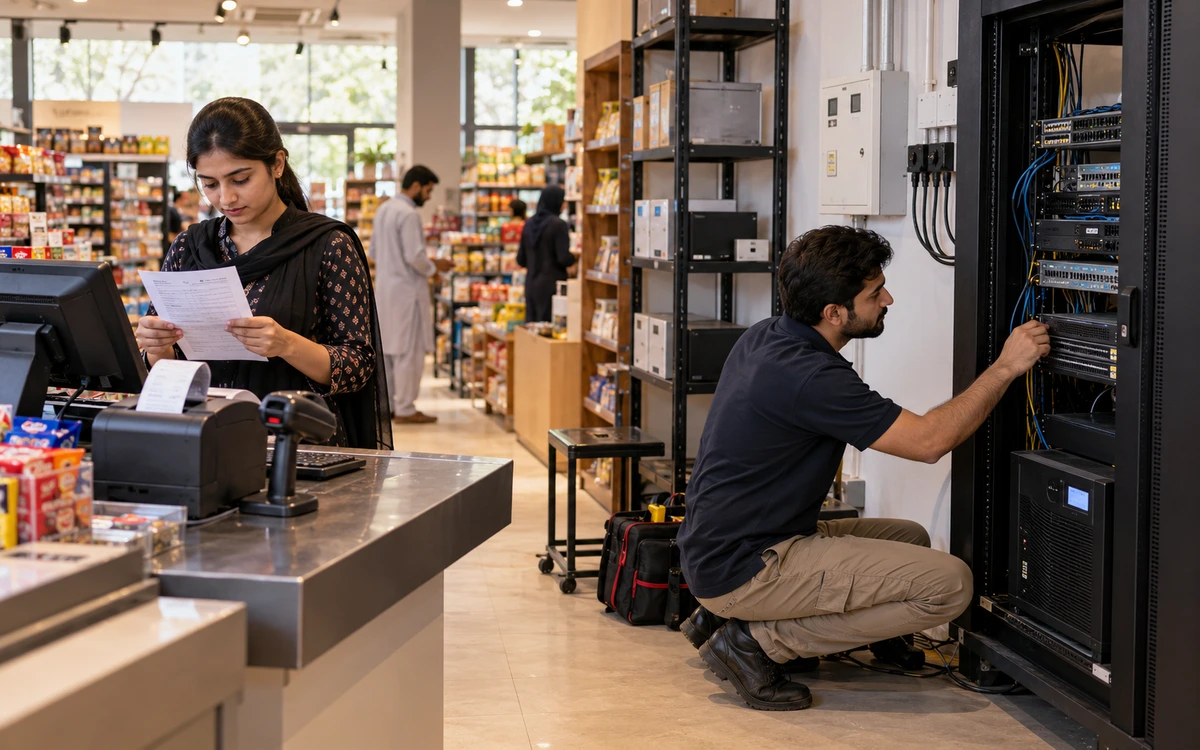
Imagine a busy grocery counter where the connection changes after the customer has begun payment. The operator needs to know whether a payment or document was accepted, whether the sale remains incomplete and what action is allowed next. Repeating the action blindly can create another problem even if the screen becomes responsive again.
Read this part of the guideA continuity plan should explain what the business can do during an interruption and how it establishes a correct position afterwards. A hybrid architecture can reduce reliance on a remote connection for selected, deliberately placed tasks. Its operational strength comes from a designed recovery process as well as local execution. The important question is whether your proposed system can demonstrate both.
Local processing creates a useful design option
AWS's retail edge reference describes an architecture using local processing to support essential store functions through network interruptions and reconnect with central services. The AWS retail edge guidance is an example of what a designed architecture can achieve. It is not evidence that every locally installed application, hybrid product or iPOS configuration has those behaviours.
For a buyer, the practical lesson is to ask which work remains possible under each failure condition. A counter that can perform a defined local task still needs power, functioning devices, reliable data and an approved operating rule. Central services and external dependencies may have their own requirements.
Separate the failures before planning the response
A lost internet connection, failed branch network, unavailable central service and damaged counter computer are different incidents. A hybrid design may isolate some of their effects, but it does not eliminate every dependency. List the components involved in the transaction and identify the point at which work can no longer proceed under the supported configuration.
Include scanners, printers, local storage and any external payment or integration step. Staff need a simple way to recognise the incident and escalate it, without attempting unapproved repairs. The counter outage runbook provides a useful structure for those first actions. A clear diagnosis prevents a problem with one printer from becoming an unnecessary restart of an entire branch.
Follow one interrupted sale to a known outcome
Imagine a busy grocery counter where the connection changes after the customer has begun payment. The operator needs to know whether a payment or document was accepted, whether the sale remains incomplete and what action is allowed next. Repeating the action blindly can create another problem even if the screen becomes responsive again.
Use a controlled test to observe this sequence. Record the last known transaction reference, the visible status and the supporting evidence available to the operator or supervisor. Ask the provider to demonstrate the approved recovery step. A locally responsive interface is valuable, but the completed sale and its settlement must also reach an explainable state.
Recovery must protect the relationship between records
Where a design includes delayed exchange of information between local and central components, the business needs a defined way to recognise pending work and resolve exceptions. Ask how repeated delivery attempts, rejected updates and conflicting information are identified. Confirm who reviews the exception and what evidence the system preserves.
These are implementation requirements, not behaviours to assume from the word hybrid. The business should be able to distinguish a completed local action from a confirmed central update. Management reports also need an understood timing context. A branch appearing on a dashboard does not, by itself, establish that all of its latest transactions have completed the same processing stage.
Compare continuity scenarios explicitly
| Scenario | Potential architectural benefit | Required evidence |
|---|---|---|
| Wide-area connection fails | Defined local tasks may avoid dependence on that connection. | The supported task list, limits and operator procedure. |
| One counter fails | Responsibilities may be separated from other working counters. | The documented failure boundary and supported restart or handoff. |
| Acceptance response is unclear | A transaction record can support investigation. | A method to determine the earlier outcome before repeating an action. |
| Central information is delayed | Local execution and central review can follow defined stages. | Pending-work visibility, update timing and exception ownership. |
Score these scenarios against observed results. A cloud system with appropriate edge capabilities may meet them too; a hybrid installation with weak recovery controls may not.
Keep restoration separate from ordinary reconnection
Restoring a damaged device or data store is a different task from resuming a temporarily unavailable connection. Define the recovery data, responsible person and supported environment. Check that the backup can be used for its intended purpose rather than assuming that a file existing somewhere proves recoverability.
Rehearse a representative restoration using approved test information. Review access, equipment and any configuration needed to resume work. The backup and recovery checklist helps separate these responsibilities. A resilient operating model needs a way to recover the local component precisely because local execution places important work there.
Close the incident with reconciliation
After service resumes, review the affected transactions, payments and stock movements over the same incident window. Identify any unresolved document or integration work. A supervisor should approve the result using evidence, not only a message that the system is working again. Use the shift-close process to connect the recovery with the cashier's settlement responsibility.
For iPOS, make this rehearsal part of the implementation discussion alongside the platform capabilities. A strong proposal should explain the design boundary, the people responsible and the steps needed to establish a correct business position after a problem.
Confirm the proposed iPOS deployment
Scope note: Confirm the execution, recovery and synchronisation behaviour of the exact proposed iPOS deployment; this article does not promise an iPOS offline mode, and iPOS Web POS requires an internet connection.
Ask iPOS to rehearse your most important interruption scenario. Approve the operating procedure and recovery evidence before relying on it during a busy trading period.
More from Insights

Owner Mobile Apps for Connected POS and ERP Management
Connect owner decisions with iPOS Web POS, Infinity ERP and mobile access. Evaluate branch context, exceptions, permissions and useful management workflow…

Customer Mobile Apps for Stronger Retail Relationships
Plan a useful iPOS customer mobile app around real customer journeys, clear records and consistent service, with owner and customer responsibilities kept…

Ecommerce Stores, iPOS Web POS and Infinity ERP
Plan an ecommerce store alongside iPOS Web POS and Infinity ERP, with clear ownership of products, stock, orders, fulfilment and customer-facing informati…