
POS for a Growing Medium-Sized Retail Business in Pakistan
A medium retailer usually needs stronger control of purchasing, stock, staff permissions and daily reconciliation, not merely a larger sales screen. iPOS can scope those requirements across local, online and hybrid configurations with optional connected business-management functions.

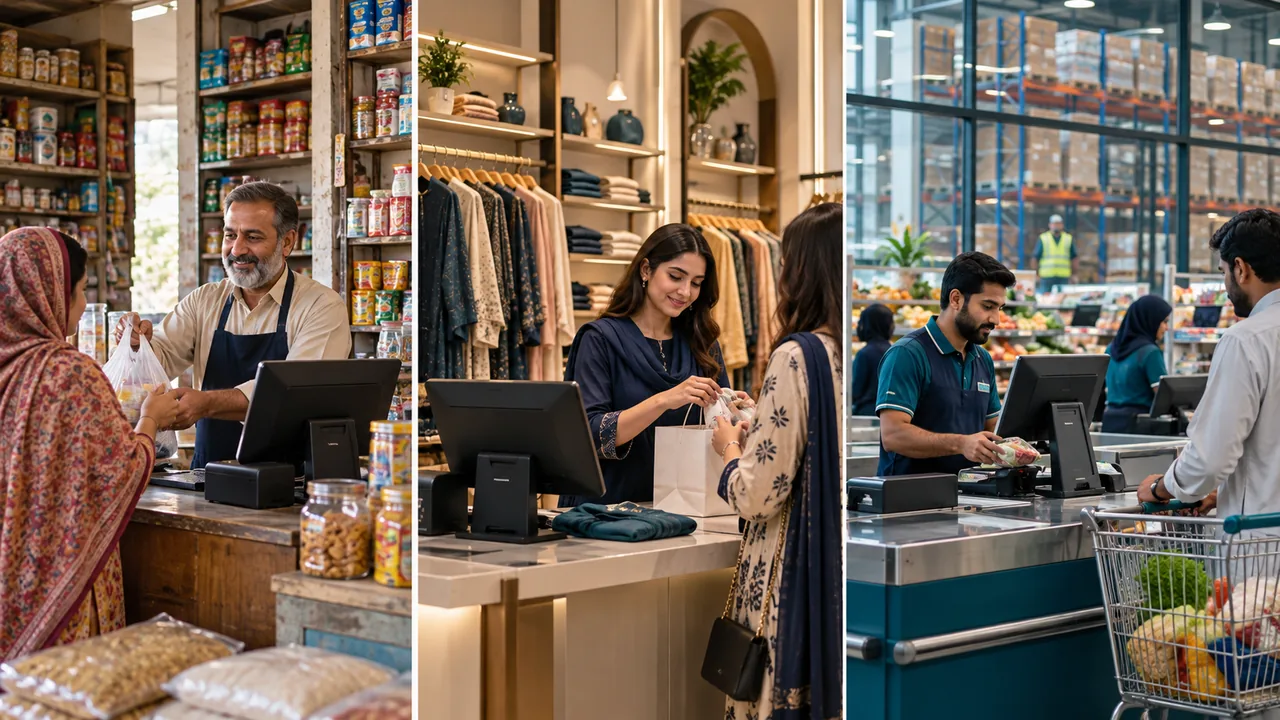
AI-generated editorial illustration.
Find the operational bottleneck first
Growth exposes weaknesses that a single owner-operated counter can hide. Staff may receive deliveries without updating quantities, change prices inconsistently or close shifts without explaining differences. Record the recurring exceptions over a working week. Separate training problems from missing software functions. This gives the implementation team a specific improvement brief and provides a baseline for checking the results.
Introduce responsibilities along with modules
Give each recurring task an owner: product creation, purchasing, receiving, refunds, cash closing and backup checks. A new module should support that responsibility rather than simply adding another screen. For example, a receiving workflow only improves stock if staff compare the delivery with the agreed purchase information and handle shortages consistently. Define who approves corrections and who reviews unresolved differences.
Plan the next stage before expanding
A second counter, store or sales channel changes access and reconciliation requirements. Test concurrent use on the proposed equipment and agree how records are shared. If connected management is needed, document what remains local and what needs internet. Infinity ERP may become relevant for wider coordination, but it should be chosen against actual management requirements rather than an arbitrary business-size label.
A practical scenario
A two-counter household-goods shop adds a stockroom and a purchasing assistant. The rollout concentrates on receiving accuracy, transfer responsibility and shift closing before adding an owner dashboard. Managers then compare exceptions weekly, so extra reporting supports a working control process rather than becoming an unused feature.
Demonstration and acceptance checklist
| Action to demonstrate | Evidence to inspect |
|---|---|
| Receive a partial delivery | The shortage has an assigned resolution |
| Run two counters together | Results remain correct under expected use |
| Process a staff refund | Authorization and records are clear |
| Review closing differences | The manager can follow the transaction trail |
Questions buyers ask
Does growth always require ERP?
No. Some businesses first need a better configured POS and clearer operating procedures. Wider ERP functions should follow a requirements review.
Can local checkout and remote reporting coexist?
A suitable hybrid arrangement can combine specified local and connected functions. Confirm the exact scope and synchronization process.
Related guides
- A Startup POS Budget: Licence, Equipment, Training and Later Growth
- How to Evaluate a Professional POS Interface Beyond Its Appearance
- Chain-Store Stock Optimization: Balance Availability Across Branches
Compare the iPOS product range or contact iPOS about your requirements.
More from Insights

A Startup POS Budget: Licence, Equipment, Training and Later Growth
A useful startup POS budget separates the initial counter requirements from optional connected services and future expansion. Selected iPOS POS editions o…

How to Evaluate a Professional POS Interface Beyond Its Appearance
A professional POS interface should help the operator complete work accurately, with clear information and predictable actions. iPOS usability should be e…
Which iPOS Model Fits Your Industry? Startup-to-Enterprise Comparison
Choose iPOS by operating requirements, not company size alone. Desktop offline POS suits local checkout needs, online Web POS suits connected browser acce…