
Fleet Credit Billing for Petrol-Pump Operations
Plan fuel-station fleet-credit requirements around customer authorisation, vehicle references, limits, statements and payment allocation before confirming software scope.
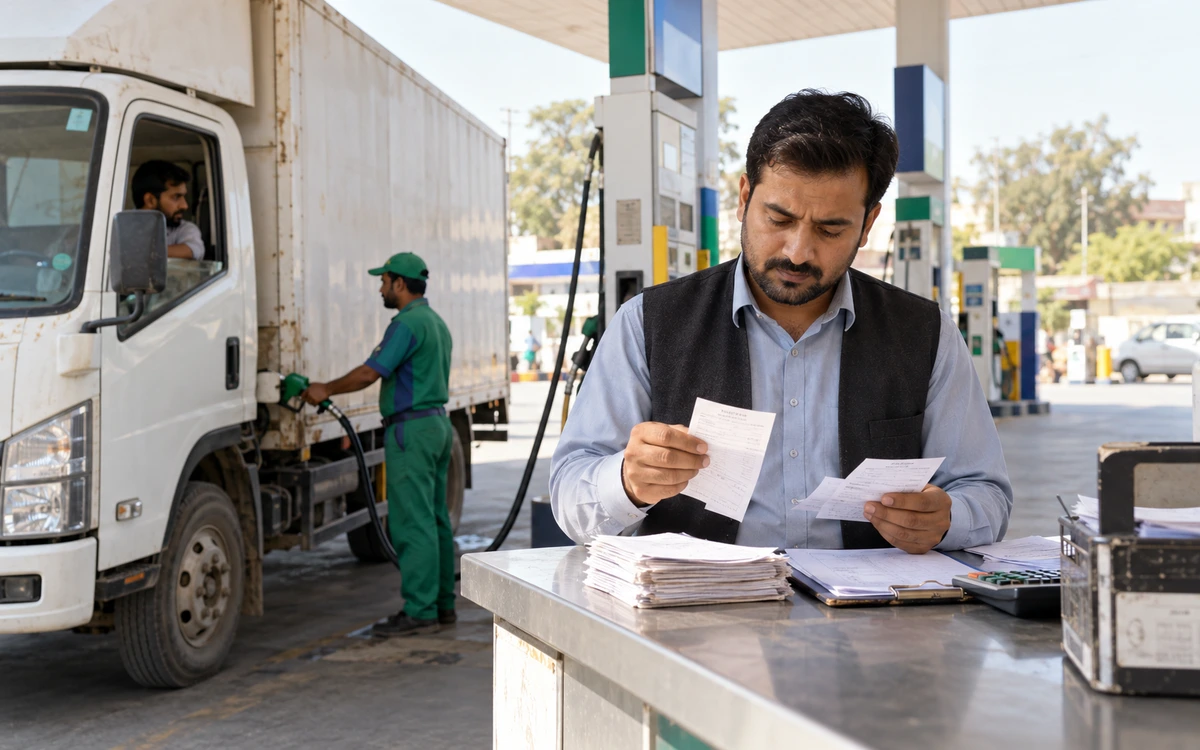
Credit belongs to an account.
Choose a stage to explore the practical checks.
Define the account and authorised references
Identify the customer account responsible for payment and the vehicle, driver or other references the business needs to record. Decide who approves changes to those references. Include a customer with several vehicles and a vehicle that should not be eligible. Ask the provider to demonstrate the exact supported authorisation process. Avoid assuming that free-text entry of a vehicle number provides the same control as a managed list of authorised references.
Read this part of the guideState the commercial rules clearly
Write down the agreed billing period, any credit conditions and the information expected on a statement. Describe limits or approvals only where the business genuinely needs them. Have the responsible person approve the commercial policy and ask the implementation team to confirm how the proposed configuration represents it. If a requirement remains manual, record the process and its owner. The counter team should not have to interpret different informal instructions from sales and accounts.
Read this part of the guideTrace one credit sale from the forecourt
Create a sample transaction using the intended pump or recorded-sale process and follow its relationship with the customer account. Compare the product, quantity, amount and customer references. Confirm the compatible equipment and modules separately from the account workflow. A successful customer-credit demonstration does not prove a particular pump or controller integration. Retain both acceptance results so the proposed installation is understood as a complete, explicitly scoped arrangement.
Read this part of the guideFleet-credit sales introduce a second relationship alongside the fuel transaction: the business must establish who is authorised to buy on an account and how that account is settled. Describe those requirements separately when evaluating Infinity forecourt and customer workflows. A general credit-balance screen does not establish every fleet-management feature.
Define the account and authorised references
Identify the customer account responsible for payment and the vehicle, driver or other references the business needs to record. Decide who approves changes to those references. Include a customer with several vehicles and a vehicle that should not be eligible. Ask the provider to demonstrate the exact supported authorisation process. Avoid assuming that free-text entry of a vehicle number provides the same control as a managed list of authorised references.
State the commercial rules clearly
Write down the agreed billing period, any credit conditions and the information expected on a statement. Describe limits or approvals only where the business genuinely needs them. Have the responsible person approve the commercial policy and ask the implementation team to confirm how the proposed configuration represents it. If a requirement remains manual, record the process and its owner. The counter team should not have to interpret different informal instructions from sales and accounts.
Trace one credit sale from the forecourt
Create a sample transaction using the intended pump or recorded-sale process and follow its relationship with the customer account. Compare the product, quantity, amount and customer references. Confirm the compatible equipment and modules separately from the account workflow. A successful customer-credit demonstration does not prove a particular pump or controller integration. Retain both acceptance results so the proposed installation is understood as a complete, explicitly scoped arrangement.
Test an attempted unauthorised transaction
Use a reference or account condition that should require rejection or supervisor review under the approved policy. Observe the cashier's options and the record available afterwards. Decide how an exceptional approval is explained and who reviews it. The business needs a practical alternative when a legitimate customer encounters a problem, but that alternative should not silently bypass the control for every future sale. Ask the provider to show the supported method rather than describing a promised future restriction.
Review the statement and settlement journey
Prepare a sample period containing several sales, an adjustment and a payment. Compare the statement with the underlying transaction records and review how the payment is allocated under the proposed process. Ask accounts to explain the remaining balance. Keep disputed transactions identifiable rather than changing a statement total without evidence. The review should establish that a customer-facing summary and the internal account history describe the same accepted set of events.
Assign responsibility for exceptions
Decide who investigates a disputed vehicle reference, an incorrect customer assignment or an unexplained outstanding amount. Retain the original transaction and the correction evidence where relevant. Connect the account review with the station's shift-close process so a credit sale is not mistakenly expected as cash in the drawer. Use the same sample account and exception cases when comparing providers, and record the exact fleet-related scope included in each proposal.
Useful next steps
Bring one fleet statement and your account-authorisation rules to iPOS so the team can demonstrate the proposed sale-to-settlement workflow. Discuss your requirements with iPOS.
More from Insights

Owner Mobile Apps for Connected POS and ERP Management
Connect owner decisions with iPOS Web POS, Infinity ERP and mobile access. Evaluate branch context, exceptions, permissions and useful management workflow…

Customer Mobile Apps for Stronger Retail Relationships
Plan a useful iPOS customer mobile app around real customer journeys, clear records and consistent service, with owner and customer responsibilities kept…

Ecommerce Stores, iPOS Web POS and Infinity ERP
Plan an ecommerce store alongside iPOS Web POS and Infinity ERP, with clear ownership of products, stock, orders, fulfilment and customer-facing informati…